FolderMagic
Coming soonEvery storage location you own, fused into one drive.
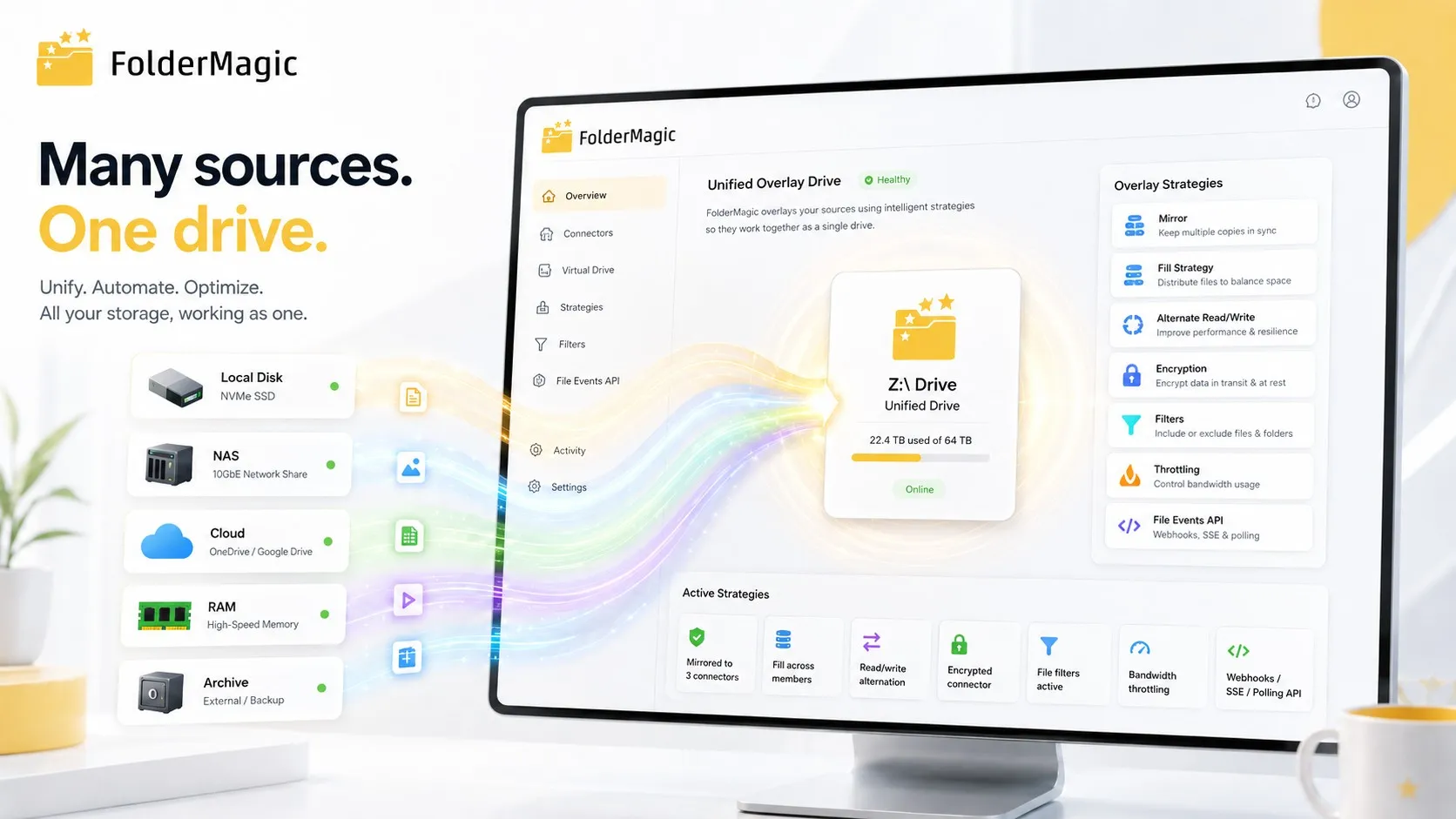
See it working
4 views · scroll or swipeCompose storage groups from individual connectors.
The idea
You already have the storage you need. It is just scattered — a fast NVMe with no room left, a NAS with plenty, a cloud bucket you pay for monthly, and an archive drive you have to remember to plug in.
FolderMagic presents all of it as one drive. Write a file to Z:\ and it lands wherever your
rules say it should. Read it back and you do not know or care where it came from. Every application
on the machine sees an ordinary folder, because that is exactly what it is being shown.
What that makes possible
Tiered storage without a storage appliance. Put the NVMe first, the NAS behind it, cloud behind that. New files land on the fast disk; when it fills, they spill to the next layer automatically. This is what enterprise storage vendors sell for a great deal of money.
Redundancy you choose per folder. Mirror the directory that matters to three locations and leave the scratch directory on one. Same drive, different rules.
Encryption exactly where you want it. Encrypt the cloud layer and leave local plaintext, using Cryptomator’s vault format or the newer Unified Vault Format. The provider stores ciphertext and holds no key.
Routing by file type or path. Photography workflows that put RAW files on the big slow disk and JPEGs on the fast one. Media libraries that split by year. Build systems that keep artefacts in RAM and results on disk. All invisible to the software using the folder.
How it is built
Underneath the single mount, each connector runs a configurable pipe stack — metering, encryption, metadata caching, throttling, content caching, filtering and events. Storage groups compose connectors, and groups compose into further groups, so an arbitrarily deep arrangement still presents as one drive.
The setup builder is a visual editor that validates a configuration server-side before you mount it, then exports it as a runnable definition. Mounting is handled by CBFS-Fuse on Windows and Linux.
A metadata cache keeps directory listings fast over slow backends, a content cache with write-back smooths out latency, and per-connector throttling stops a cloud sync from saturating the line.
Licensing
FolderMagic uses the same licensing as every Speedbits product: a community license, free for private and non-commercial use, and a commercial license for business use.
What you get
Many locations, one drive letter
Stack local folders, network shares, cloud buckets and RAM disks into a single mount. Reads fall through the layers; writes follow the rules you set.
Write strategies that match real problems
Mirror to every member for redundancy, fill fast storage before spilling to slow, split by file type or path, distribute across members, or write-one-read-all.
Automatic storage tiering
Put an NVMe drive in front of a NAS in front of cloud storage, and let FolderMagic keep hot data fast and cold data cheap — with no change to how anything reads the files.
Encryption that travels with the data
Cryptomator vault format 8 and the newer Unified Vault Format, applied per connector. Encrypt only the cloud layer, or all of it. Your keys.
Rules down to the file
Send JPEGs to one location and RAW files to another, filter by pattern, size or date, throttle a slow backend to a set bandwidth — and still see one folder.
Built to be automated
An event API with webhooks, server-sent events or polling, API-key auth, HMAC-signed payloads and a deny-by-default policy.
FolderMagic is coming.
Tell us what you would point it at. What people ask for is what decides the order things get built in.