SmartRecall
Coming soonAsk your company's own files a question, and get an answer.
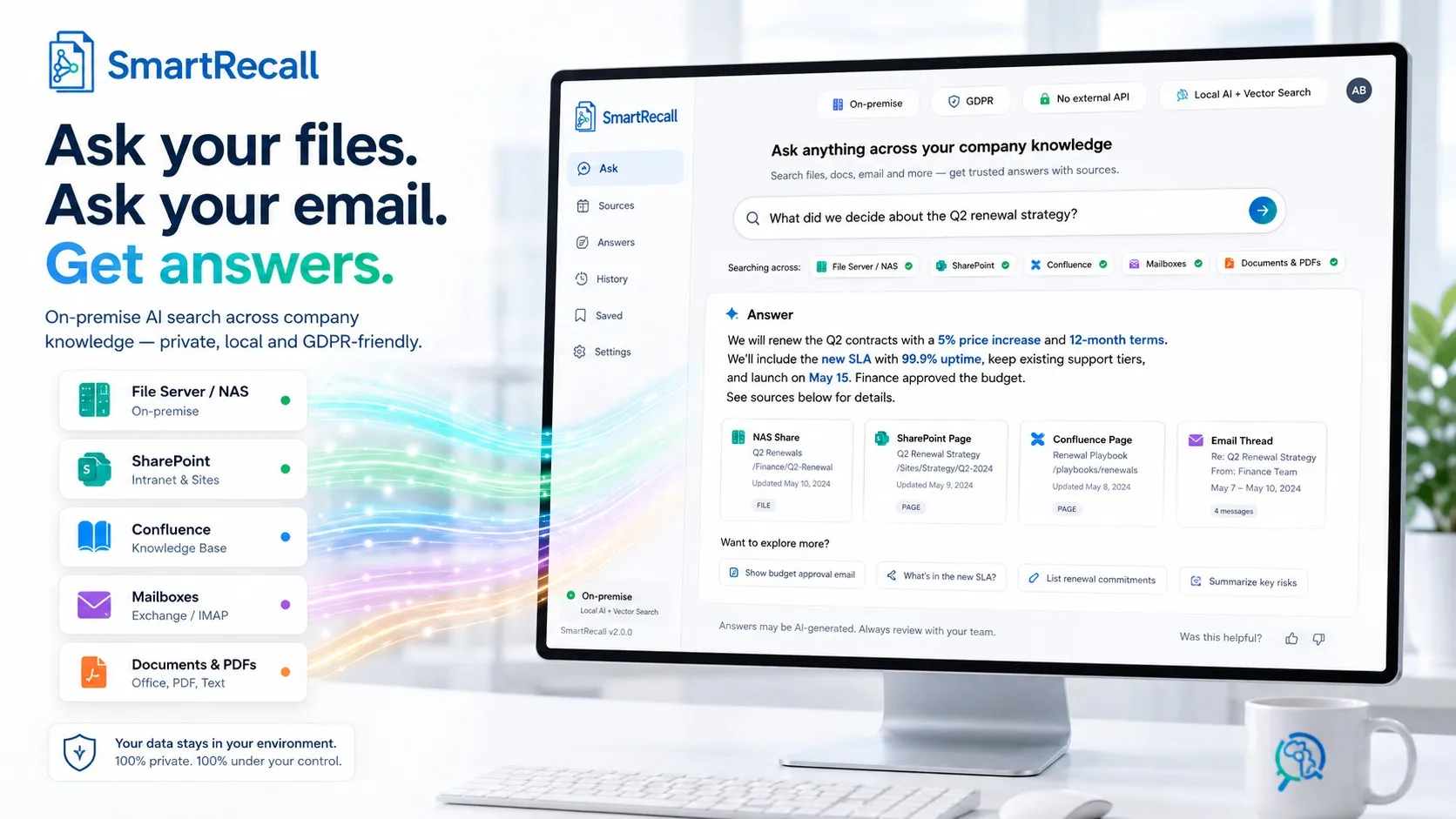
An on-premise AI search across everything a company already has — file servers, NAS shares, SharePoint, Confluence and staff mailboxes. SmartRecall indexes it all, and answers questions from it in plain language. Nothing is sent to an external service.
On-premise · GDPR-compliant · No data leaves the company
See it working
5 views · scroll or swipeOne box over everything the company has. The badge is the point: the models run on this server, and mail is fetched through Microsoft Graph and then processed locally — nothing is handed to an outside service to be read.
Every company already has the answer to most of the questions its staff ask each day. It is in a PDF on a NAS share, a spreadsheet on SharePoint, a Confluence page nobody has opened since the migration, or an email thread from two years ago. Knowing it exists is not the problem — finding it again is.
SmartRecall indexes all of it and lets people ask in plain language.
What it searches
SmartRecall connects to the places documents actually live, rather than asking anyone to move them somewhere new:
- Local storage and NAS — SMB and NFS shares, mapped network drives, plain directories on a server
- SharePoint — document libraries and sites
- Confluence — spaces and page trees
- Email accounts — employee mailboxes, indexed with their attachments
Documents are parsed as they are found. PDFs — including scanned ones — Word, Excel and PowerPoint files are extracted, split into passages, embedded and kept current as they change.
Why on-premise is the point
The obvious way to build this is to send everything to a hosted model API. That is also the reason most companies cannot use tools like it: the material worth searching is exactly the material that must not be handed to a third party — contracts, personnel files, pricing, patient or client records.
SmartRecall runs the whole pipeline on hardware you own. Parsing, embedding, the vector store and the model that writes the answer all sit inside your network. There is no external API call to make, so there is no transfer to document, no processor agreement to negotiate, and no third-country transfer to justify under the GDPR.
Status
SmartRecall is in development and not yet available to buy. If it sounds like something you need, tell us what you would point it at — the source systems people ask for are what decides the order connectors get built in.
What you get
Every source, one search box
Local disks, NAS boxes, mapped network drives, SharePoint sites, Confluence spaces and employee mailboxes are indexed together. One question searches all of them at once, instead of four separate searches that each miss something.
Indexing that happens on its own
Point SmartRecall at a share or a mailbox and it keeps itself current. PDFs, Word documents, spreadsheets, presentations and email are parsed, chunked and embedded automatically as they appear and change.
Answers, not a list of filenames
Retrieval-augmented search means you get the passage that answers the question, with the document it came from — rather than forty hits to open one by one.
Email is a first-class source
Most of what a company actually decided is in somebody's mailbox. SmartRecall indexes email accounts alongside documents, so a decision made in a thread two years ago is as findable as one written up in a file.
Nothing leaves the building
The models run on your own hardware. No documents, no questions and no embeddings are sent to a third-party API, which is what makes it usable for material that could never be pasted into a hosted chatbot.
Built for the GDPR position you already hold
Because processing stays on premise, there is no transfer to a processor outside your control and no third-country transfer to justify. Access follows the permissions the source systems already enforce.
SmartRecall is coming.
Tell us what you would point it at. What people ask for is what decides the order things get built in.