CodeLeague
Free editionMore transparency. Higher productivity. Lower development costs.
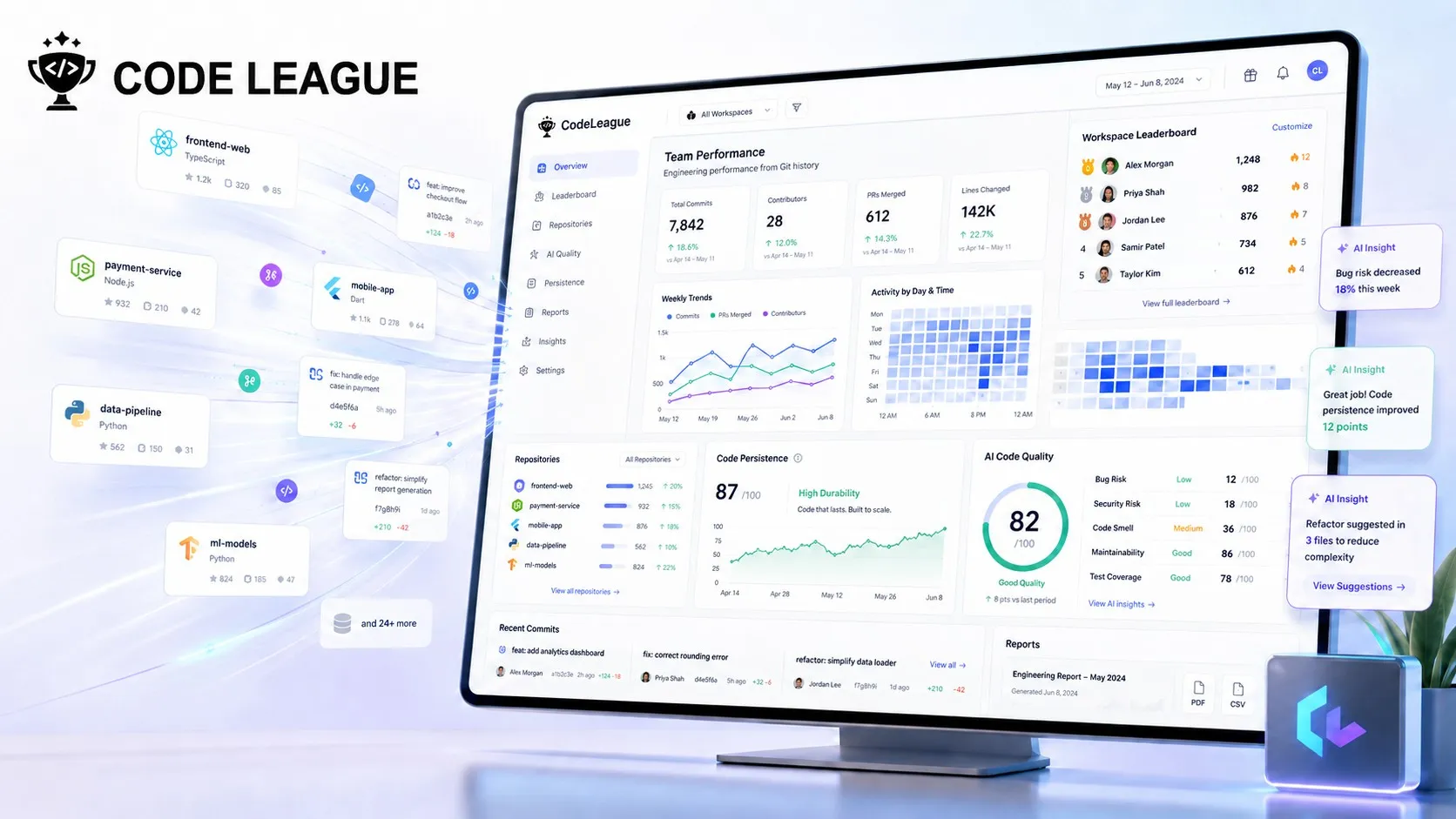
CodeLeague turns the Git history across all your repositories into clear engineering metrics, quality insights, trends and team-wide visibility.
See who is contributing, where development effort is going, how quality is changing and where problems may be emerging — across one repository or hundreds.
Add AI code analysis to judge the quality and risk of the code itself, not just how much of it was written.
Git analytics · AI code quality · Cross-project insights · Customizable leaderboards
See it working
5 views · scroll or swipeContributors ranked by whatever you decide counts. The scoring formula, the time range, the branches and the repositories are all filters — so the same data answers "who shipped most this month" and "who did the highest quality work this quarter" without leaving the page.
Increase productivity. Reduce development costs.
Software development is one of the largest cost centers in many companies — yet often one of the hardest to measure and manage effectively.
Sales teams are measured by revenue. Support teams by tickets resolved and customer satisfaction. But engineering performance is still frequently evaluated through meetings, subjective impressions, and incomplete visibility — a challenge that has only grown with distributed and remote teams.
CodeLeague brings transparency to software development.
Connect the Git repositories you already use and turn development activity into clear, actionable insights across developers, teams, projects, and time. Track commits, code contributions, development patterns, and quality indicators to better understand where engineering resources are being spent and where productivity can improve.
With better visibility, managers can identify bottlenecks, recognize high performers, set meaningful incentives, allocate resources more effectively, and ultimately get more value from every engineering dollar spent.
Identify your Rockstars!
Some of the best engineers on a team are the least visible. They do not present their work in stand-up, they do not campaign for credit, and they are rarely the loudest voice in a review. In an office you noticed them eventually anyway. Spread across cities and time zones, often you simply do not.
The Git history already knows who they are. CodeLeague surfaces the developer who contributes steadily month after month, who quietly works across five repositories at once, and whose commits keep scoring well when the AI analysis looks at them — the people who are easy to overlook precisely because nothing about their work is dramatic.
It works the other way round too. Someone whose contribution has quietly fallen off for two months is visible long before it becomes a conversation nobody prepared for.
See across every repository, not just one
Real engineering teams rarely work in a single repository. A developer may contribute to a frontend, a backend, a mobile application, shared libraries and internal tooling in the same month.
CodeLeague groups repositories into workspaces, so you see contribution across the whole product rather than judging people one repository at a time. When an organisation runs dozens or hundreds of repositories, that is a view which would otherwise be almost impossible to assemble by hand.
Activity
Commits, changed lines, net contribution, development frequency and trends over any period you choose — so you can see where engineering capacity is going, and how that changes across weeks, months and projects.
Code quality
AI analysis of individual commits for quality, maintainability and likely bugs.
It is not handed the diff in isolation. CodeLeague builds context from the surrounding codebase — symbols, imports, project structure — so the model can work out what the developer actually changed.
Use Claude, OpenAI, Gemini or AIMLAPI with your own API key. Your source code goes directly to the provider you choose; it never passes through our infrastructure.
Something your team will actually look at
Metrics only help if people use them. CodeLeague turns engineering data into dashboards, charts, heatmaps and reports that are easy to read — one developer, one repository, or the whole organisation.
And if you want it to be more engaging than a table, there is a customizable leaderboard with medals, badges and streaks. You decide how scoring works, and can weight activity, contribution, AI quality, or any combination. Use it for team challenges and recognition — or leave it switched off and treat CodeLeague purely as an analytics platform.
Built for engineering leaders
- CTOs and VPs of Engineering — where effort is going across every team and project, without collecting numbers by hand from a dozen systems.
- Engineering managers — team trends and contribution across projects, as another input into one-to-ones and planning rather than a replacement.
- Tech leads — quality and code risk rather than volume, and which parts of the codebase are changing heavily.
- Distributed teams — the shared, factual picture an office used to provide informally, out of work already recorded in Git.
Engineering metrics for the age of AI-assisted development
AI coding tools have made traditional development metrics much less meaningful. A developer can generate hundreds of lines in minutes. Another can delete five hundred and leave the system considerably better.
Volume alone was always a weak proxy for contribution. It is now a bad one.
CodeLeague pairs activity with AI-assessed code quality, so you can see not only how much changed, but what kind of work was produced — which matters more every month that AI-assisted coding becomes ordinary.
From engineering activity to management reporting
CodeLeague does not have to stay open on somebody’s desktop. Create weekly engineering summaries, scheduled analyses, PDF reports, shareable links, and team and project dashboards.
The Server edition adds role-based access and scheduled email reporting, which turns it from a tool on one machine into a central engineering intelligence service for the organisation.
It installs on any Linux machine with Docker in two lines — or from the app catalogue of Infinity Tools, if you are already running that, which adds the reverse proxy, the TLS certificate and the backup schedule for you.
Measuring engineering without reducing engineers to a number
No single metric tells you whether someone is a good developer. Commit counts do not. Lines of code do not. An AI score does not either. So CodeLeague gives you several signals at once — activity, contribution and quality — and keeps the individual numbers visible behind whatever the leaderboard is weighted to show.
Better visibility leads to better questions, and better questions lead to better engineering decisions.
What you get
One view across your dev team
Analyze developers and repositories individually, or group projects into workspaces for organisation-wide visibility across hundreds of repos.
Engineering analytics worth looking at
Commits, contribution, activity, trends, heatmaps and file types, over any timeframe you choose — rendered as charts you can put in front of a board.
AI code-quality analysis
Judge quality, maintainability and likely bugs with Claude, OpenAI, Gemini or AIMLAPI, using your own API key. Your source goes straight to the provider you picked and never passes through our infrastructure.
Context, not just the diff
The analysis is given the surrounding codebase — symbols, imports, project structure — so the model can tell what the change actually did, rather than guessing from a patch in isolation.
Squash merges do not lose the author
Squash-and-merge normally destroys authorship. CodeLeague reconstructs it, so the person who wrote the code is the person who gets credit for it.
Customizable leaderboards
Combine activity and quality metrics with your own scoring model, with optional medals, badges and streaks — or leave the leaderboard out entirely and use CodeLeague purely as an analytics platform.
Reports that leave the tool
Weekly summaries, scheduled analyses, PDF export and shareable links. The Server edition adds role-based access and scheduled email reporting.
Your infrastructure, your choice
Run it on the desktop, or as a Docker container on your own servers. No hosted service in the middle either way.
GDPR compliant
CodeLeague runs locally on your desktop or an on-premise (or cloud) server. The statistics and insights never leave your infrastructure.
Download CodeLeague
v1.0.37Released 16 September 2026Pick the build for your machine. Nothing is installed in the background, no account is created, and the application does not phone home.
Desktop application
The Desktop Community edition is free for personal use, on up to two repositories with five authors each.
Using this at work needs a license. The download is the same application either way — the Community edition is the licence, not a cut-down build. Unlimited repositories and authors, and AI code-quality analysis, come with a Desktop or Server licence. See commercial licensing.
Server edition
The headless build, for running CodeLeague as a shared service while everyone else works in a browser. Serving it over a network inside an organisation is exactly what the commercial license is for.
Already running Infinity Tools? CodeLeague is in its app catalogue — install it from there and the reverse proxy, the TLS certificate and the backup schedule are configured with it.
Install on a Linux server
curl -fsSLO https://raw.githubusercontent.com/smartinventure/codeleague-installer/main/install-codeleague.shbash install-codeleague.shNeeds Docker. Installs the container, a compose file and a host-side updater. The first line only downloads the script, so you can read it before the second one runs it. Running the same two lines again updates an existing install.
All builds and release notes on GitHub ↗ · Every button above resolves to the newest release, so these links never go out of date.
Desktop Community
For personal use on a couple of repositories.
- Commit and lines-of-code analytics over any time span
- Leaderboard with medals, badges and streaks
- Multi-repository workspaces
- Squash-merge attribution
- Author merging and exclude templates
Community license. Personal use only.
Desktop
Most popularThe full application on one machine, with AI code review.
- Everything in Community, without limits
- AI code-quality analysis with your own API key
- Bring your own provider — Claude, OpenAI, Gemini or AIMLAPI
- Agentic commit analysis with symbol extraction and import graphs
- Scheduled analyses and weekly email reports
- + 2 more →
Perpetual per-machine license. Includes one year of updates and support.
Server
Dockerised server deployment for the whole team.
- Everything in Desktop
- Runs as a Docker container on your own server
- Role-based access control for admins and users
- Cloud git import from GitHub and GitLab, including self-hosted
- SMTP email reports and ntfy notifications
- + 1 more →
Perpetual server license. Includes one year of updates and support.
Need more servers, several products, or an invoice? Ask for a quote. Lost a license key? Retrieve it here.
Try CodeLeague on one machine and see.
The free edition is the same software, limited to personal use.